

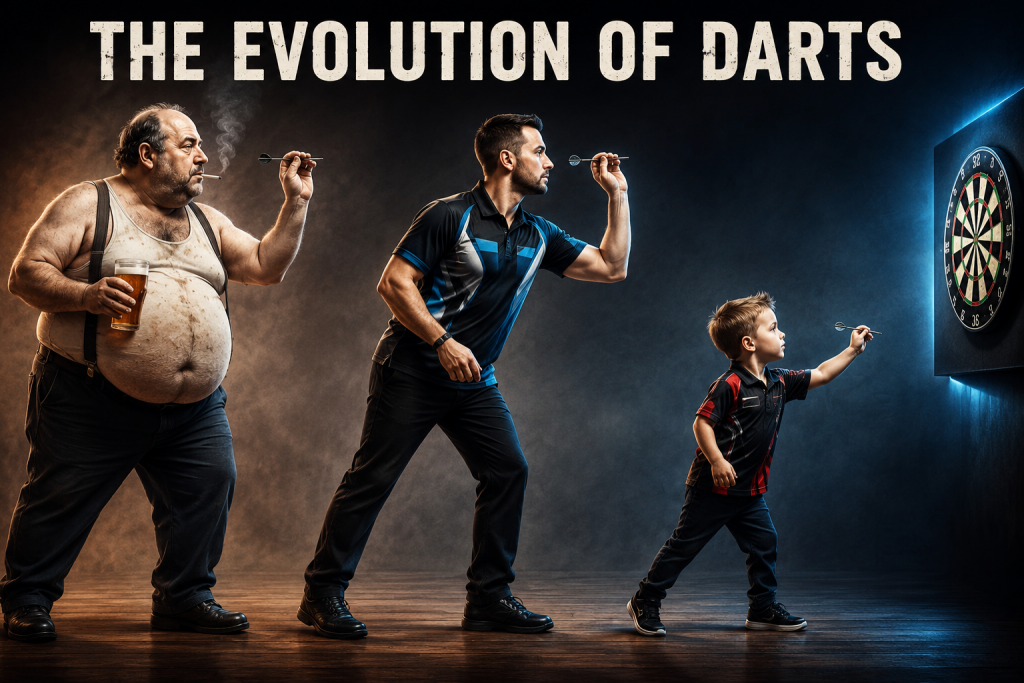
Remember the days of yonder where your average darts player would be a bloke called Dave in his mid-50s, fag in one hand, darts in the other and taking the occasional swill of Skol Lager between throws in a smoke-filled, dingy backstreet venue that smelled like stale beer, disappointment and somebody quietly pouring their heart out to a disinterested barmaid?
Sadly, I do. I probably was that person mentioned in the latter.
Back then, it seemed every lad we watched on television was shaped like a capital D, with a beer belly protruding so far forward it arrived at the oche three seconds before the rest of him. These heroic athletic specimens would then attempt to launch chunky bits of brass into dartboards containing more visible metal than a scrapyard. Bounce-outs happened with such frequency that spectators in the front row needed the reflexes of a Vietnam veteran.
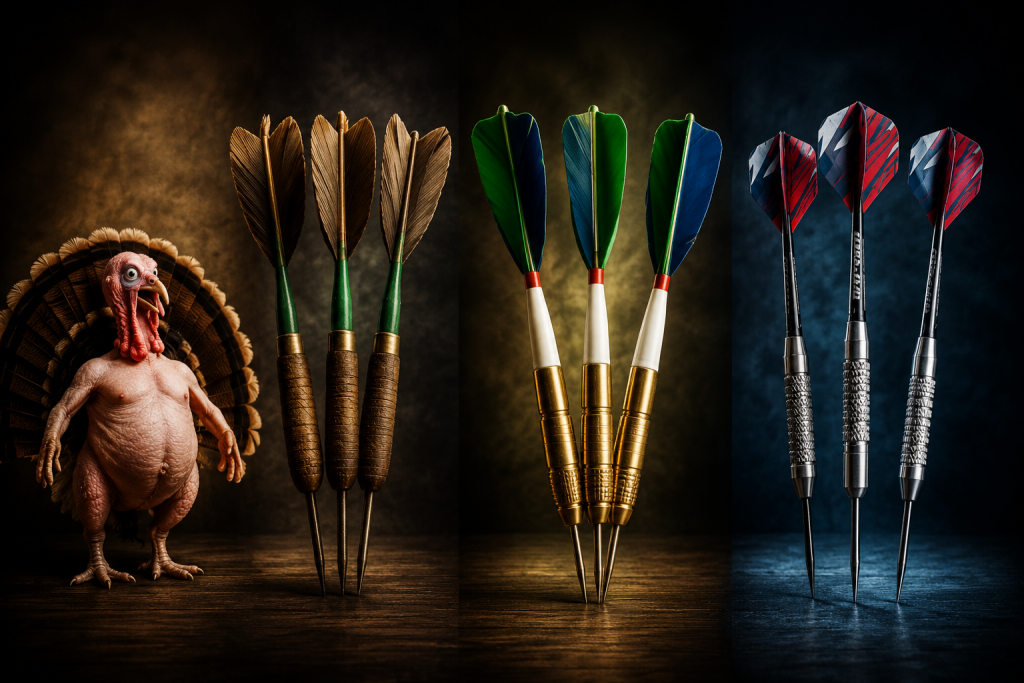
As time rolled on, things changed. You still had your fair share of middle-aged, hairy-armed blokes whose resting heart rate probably resembled a microwave timer, but the equipment started evolving. Suddenly, feathers on the end of darts vanished and were replaced by little triangular plastic flights designed by someone who looked at a bird and thought, “Nah, too natural.” Bounce-outs became less common due to reduced wiring on the boards and eventually darts entered what can only be described as the Tungsten Renaissance.
At some point, somebody suddenly remembered tungsten existed despite it being discovered in the 18th century. Apparently, after two hundred years mankind collectively realised, “Hang on… this is actually much better than brass.” An astonishing breakthrough only slightly less delayed than the invention of sliced bread. Interesting fact: that came in 1928 courtesy of an American bloke. Baker I hear you ask? No, it was in fact a jeweller who quite frankly, should have been nowhere near that discovery.
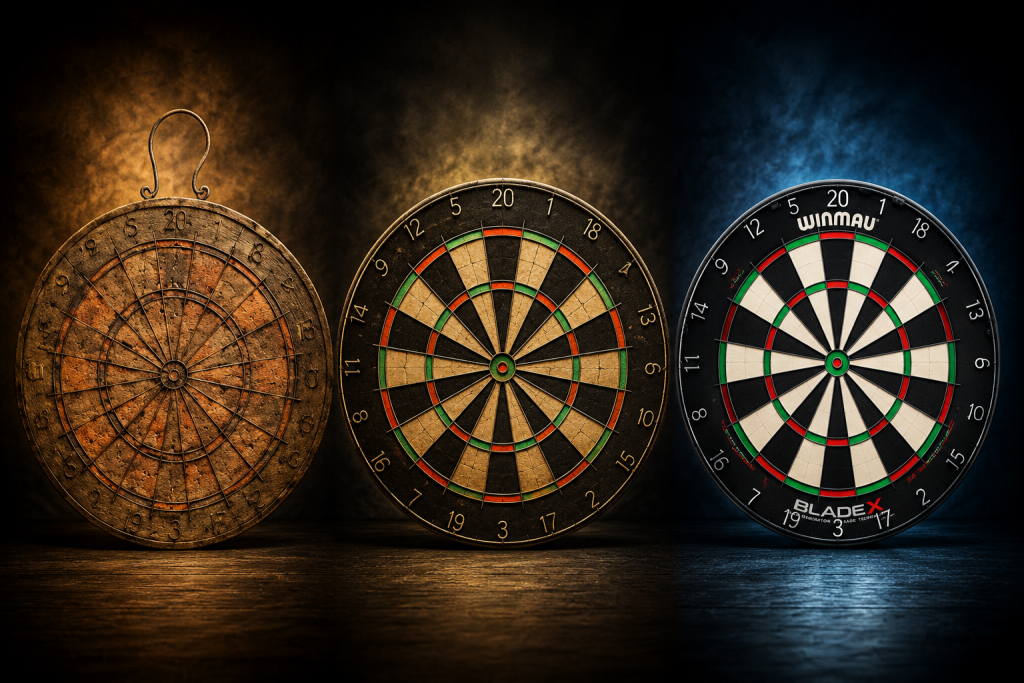
Then dartboards themselves evolved. Gone were the days where they looked like somebody had spray-painted a giant bog roll and nailed it to a pub wall beside a broken jukebox. Boards became sleeker, sharper and supposedly made from cork. Although from the look of some old county venues, it still appeared as though manufacturers had simply glued together fifty wine bottle tops using Pritt Stick and blind optimism.
Nowadays, equipment evolution has gone absolutely berserk. Players throw at boards made from millions of tightly compressed high-grade sisal fibres harvested from the agave plant – whatever one of those is. It sounds less like sports equipment and more like something Gwyneth Paltrow would rub on her elbows before charging £400 for it online. I doubt the lads at Winmau are expert botanists, although perhaps one wandered around the Chelsea Flower Show, glanced at a plant and suddenly thought, “That’ll do nicely for Humphries to smash 180s into.”
Tungsten meanwhile remains king, meaning Spanish brothers Juan José and Fausto Elhuyar unknowingly played a pivotal role in the future of professional darts. Admittedly, when they discovered the metal in the 1700s they were probably not anticipating a bloke from St Helens would one day use it in front of 10,000 drunk German singing to soul-destroying pop songs. Yes Celine Dion if you’re reading this – unfortunately that reference belongs to one of your tunes love. You’re warbling of that Titanic soundtrack certainly doesn’t want to make my heart go on. Stop for four minutes ideally.
The player demographic has changed dramatically too. Yes, legends such as Gary Anderson, Peter Wright, Raymond van Barneveld and Mervyn King still roam the circuit keeping the average age of moaning dangerously high, but the modern PDC is now swarming with players in their twenties and early thirties. Some of them don’t even weigh more than a family of hippos after an extended visit to McDonald’s.
Fitness, nutrition, psychologists and sports therapists now dominate the professional game. Most elite players actually look after themselves instead of treating their body like a stolen 1987 Vauxhall Astra being ragged around an industrial estate at 2am by someone named Gaz. If you’re still old, overweight and world class nowadays, fair play to you. But that breed is slowly disappearing like net curtains.
For the first time in PDC history, we recently crowned a teenage World Champion. Then, because he is simply that good, he went and won it again a year later. At this point almost every major title in the sport belongs to somebody either relatively or absurdly young. Granted, 19-year-old Luke Littler currently owns most of them like an aggressive property developer playing Monopoly, but the remaining titles sit with Gian van Veen and Luke Humphries – both practically embryos in darting terms.
And the future somehow looks even younger. Take Mitchell Lawrie for example. The Scot is just fifteen years old and firing in 180s and nine darters at a rate normally associated with Lionel Messi free-kicks on beginner difficulty mode. Granted, the Argentine is currently playing in the Saudi League where scoring can occasionally appear easier than an ugly ginger bloke finding romance in a brothel, but the talent is undeniable.
Honestly, it won’t be long before I’m sat quietly in a pub minding my own business when a young mother wheels in a pram, the toddler climbs out still wearing Peppa Pig shoes, picks up three tungsten darts and proceeds to batter me whilst asking for a Fruit Shoot during the interval. That’s how absurdly young elite talent is becoming.
I genuinely believe within five years the majority of the PDC main circuit will be thirty or under. And no, I don’t mean stone. At this rate the Development Tour will eventually need lowering to children barely capable of walking upright. By then they’ll probably already average 95 and complain about their throw being “slightly off” after missing tops twice.
And I’m not exaggerating. Well… maybe a little. But you get the drift.