



There are some people in life who spend years trying to convince themselves they are good at something. They need reassurance, encouragement and the occasional motivational quote slapped across a sunset image on Facebook.
Not this girl! Which brings me nicely onto the subject of Band On Target’s latest exclusive interview with the wonderfully talented Paige Pauling.
Still a teenager – until 15th March 2028 to be exact – the 18-year-old whizz kid from Kent has inadvertently forced her parents to build one hell of a trophy cabinet. Either that, or her Dad went into IKEA and they said he may as well just hire the warehouse.
All in all, Paige has racked up about fifty Youth accolades and countless others, including SIX senior WDF ranking titles in just the past two years. Most girls her age are obsessed purely with stocking up on make-up – not this one. She collected silverware at the rate of having to hire someone to keep them all shiny and polished.
So, let’s delve inside the mind of one of the most prestigious darting prodigies on the planet and try to find out the story behind her bewildering success. Probably down to being incredibly good at darts. I was right.
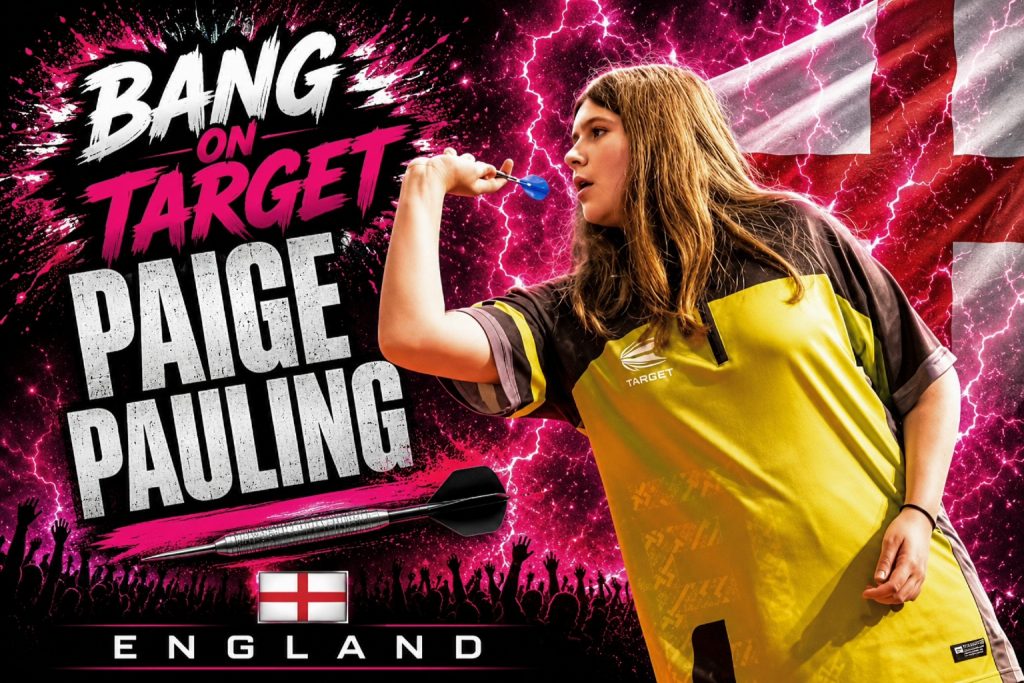
CHAPTER ONE: PAIGE ONE – INTRO TO THE ARROWS
Before we dive into rankings, trophies and enough finals appearances to make most players green with envy, it is worth finding out who Paige actually is away from the dartboard.
After all, every sports interview eventually reaches that moment where we discover whether the athlete spends their spare time climbing mountains, swimming with sharks or posting inspirational nonsense on social media.
Thankfully, Paige remains refreshingly normal.
“I’ve just finished my A Levels, so at the moment I enjoy spending time with my friends and getting out and about whenever I can.”
That’s it. No secret life as an astronaut. No part-time career fighting crime. No claim that she rises at 4am every morning to meditate while balancing on a mountain peak. Just a teenager who has finished her A Levels and likes seeing her mates.
Frankly, in today’s world that level of honesty deserves some sort of medal. Social media has convinced half the population they need twelve side hustles, a podcast and a personal brand before breakfast. Paige appears quite content simply being Paige.
Like most young players, her darts journey started with somebody else introducing her to the game. In this case, the culprit was her brother.
“I’ve been playing darts for seven years. However, when lockdown happened, I didn’t really pick up a dart again until it was over. My brother got me into the game as he also plays, and I used to go along and watch him compete in youth tournaments.”
“One day, I decided to give it a go myself and it turned out I was actually quite good. So, I entered my first girls’ competition when I was 11 and made the final at my very first attempt.”
“Actually quite good” feels like Usain Bolt admitting to being “reasonably quick”. There are people reading this who have spent seven years attempting DIY projects and still cannot put up a shelf without creating structural concerns. Paige had a go at darts and promptly reached the final of her first girls’ tournament.
Most of us try a new hobby and discover hidden talents roughly equivalent to a three-legged giraffe attempting ballet. Paige tried darts and discovered she was rather good at it. Life can be infuriatingly unfair at times.
The influence of her sibling extended beyond simply introducing her to the sport. When asked who inspired her in the early days, the answer was immediate.
“My brother inspired me at the start of my career because he was the only player I really knew. I’d never watched darts before then, and he was doing very well, so he naturally became my inspiration.”
That is the sort of answer that guarantees her brother will one day, never pay for his own drink at a family gathering again.
Every Christmas dinner for the next thirty years will almost certainly feature him casually reminding everyone that he was the inspiration behind one of the game’s brightest young talents. If there is a trophy for smug siblings, he is already engraving his name on it. And fair play to the lad.
These days, however, another player has taken over inspiration duties.
“Now I’d say it’s Beau Greaves because she’s won pretty much everything there is to win in the Women’s game and is now doing really well against the men on the PDC circuit too.”
It is difficult to argue with that assessment. Beau Greaves is just stupidly good. The fact Paige points towards the Doncaster Ace says plenty about her own ambitions. She is not looking at what has been done. She is looking at what might still be possible.
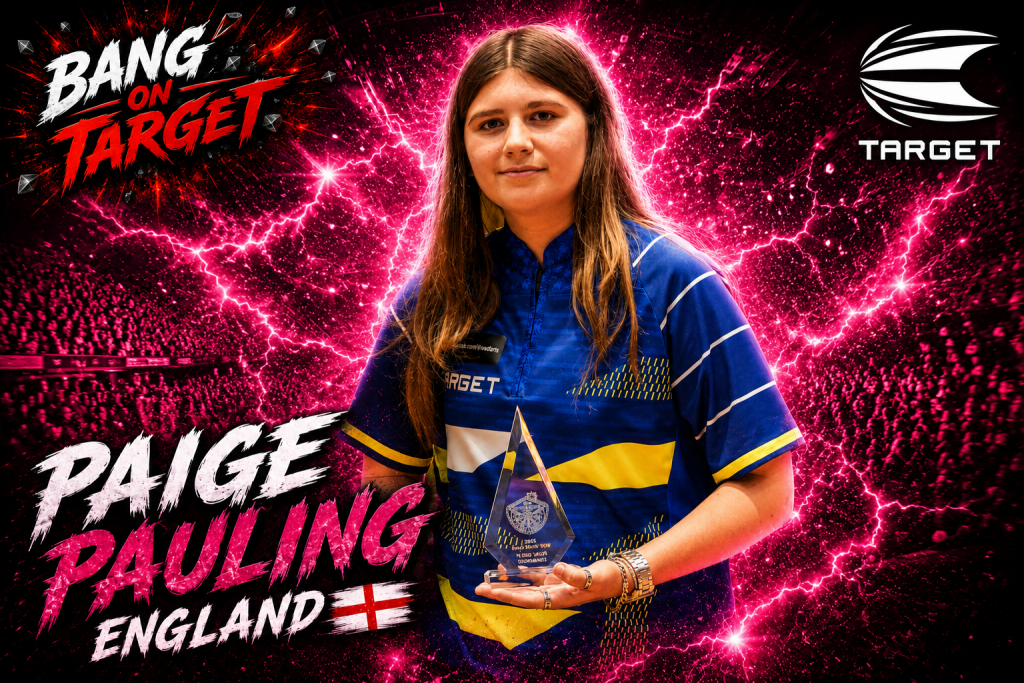
THE DREADED Q-SCHOOL JUNGLE CONUNDRUM
One of the questions every talented young darts player eventually faces is whether they intend to head to PDC Q-School. It follows promising youngsters around like a persistent relative asking when they plan to get married. No matter how many times you answer it, somebody asks again five minutes later.
Paige, however, sounds in no rush whatsoever.
“One day I’ll probably give it a go depending on where my game is, but probably not any time soon as I’d rather set myself more goals in the WDF for now as I’m transitioning from youth to senior level.”
There is a maturity to that answer which is often missing in modern sport. Everybody wants everything immediately these days. We live in a world where people complain if their takeaway arrives eight minutes late.
Patience has become rarer than a stress-free Ryanair flight. Paige sounds perfectly happy taking things step by step, building experience and chasing goals in the WDF before considering what comes next.
TAKING A PAIGE OUT OF THE TEENAGER’S BOOK
When discussing Paige Pauling, however, it is impossible to avoid her achievements. For somebody so young, the list is already substantial. The sort of list that makes another players glance at their own CV and quietly close the document before anybody sees it.
So does she surprise herself with what she has achieved? Not even slightly.
“What I’ve done in this game at my age is something I’m incredibly proud of. But to be honest, I wasn’t particularly surprised when I won those tournaments because I know what I’m capable of.
“Every event I entered, I genuinely believed I could win, and when I did, it simply became another achievement to tick off the list before my attention immediately turned to the next challenge and the next tournament.”
That is not arrogance. It is belief. There is a huge difference. Arrogance is turning up with no evidence. Confidence is turning up carrying a folder full of receipts. Paige sounds like somebody who has put the work in, knows what she is capable of and sees absolutely no point pretending otherwise.
Sportspeople spend years trying to develop that mentality. Some never manage it. Perhaps the most interesting part of her answer came immediately afterwards.
“This year hasn’t been my best so far, and it has been challenging not winning at the rate I’ve become accustomed to throughout most of my career.
“However, I know every player goes through peaks and troughs, and I’m doing everything I can to rediscover that winning feeling and get back to producing my very best darts.”
That is the reality of sport. Even the best players eventually discover that confidence can disappear faster than a referee who has just been asked to buy the next round. Form comes and goes. Winning streaks end. Performances fluctuate.
The difference between good players and great players is usually how they respond when things are not going their way. Paige sounds frustrated, certainly, but not remotely defeated. More annoyed than worried. More determined than concerned.
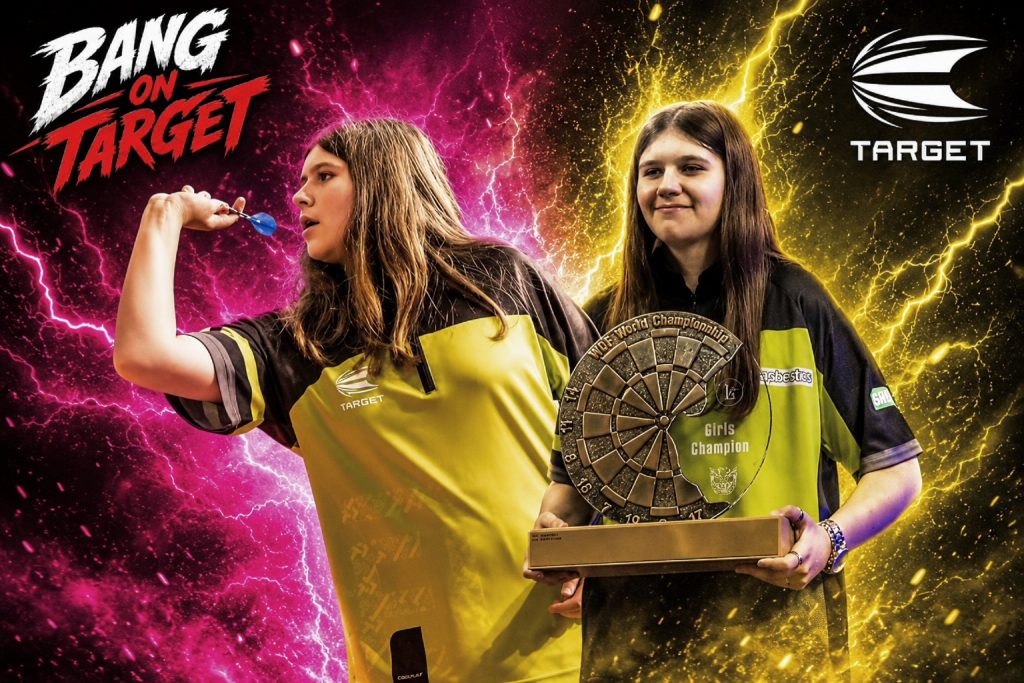
THE ONE WHERE PAIGE GOES TO VEGAS
That mindset was put to the test recently in Las Vegas, where she walked away with two titles and two runner-up finishes. Most people would describe that as an excellent week. Paige, being Paige, had a slightly different take.
“Obviously, winning the pairs title with Ruby [Grey] was a great start to the week, even though I didn’t play well at all. Results-wise, it was a pretty successful tournament, but in terms of my actual performances, I felt they were pretty atrocious if I’m being honest.
“I don’t think there were many matches where I played particularly well, and even when I was winning, it wasn’t in the way I like to win. A lot of it felt quite scrappy.”
Only a darts player could describe a week involving multiple titles and finals as “pretty atrocious. Imagine a footballer winning several trophies before announcing they were disappointed because one pass went slightly astray in February.
Yet this is exactly why top players become top players. They refuse to settle. They refuse to pat themselves on the back for mediocrity. Thankfully, Paige did eventually find a positive from Vegas.
“I suppose the positive is that even when I feel like I’m playing at my worst, I can still make finals and find a way through the matches where I’m not performing particularly well.”
And that might actually be the most significant thing the youngster said during the entire interview. Most good arrow-smiths can win when they are throwing brilliantly. Elite players find ways to win when they feel average. The really dangerous players still reach finals when they think they are playing terribly.
If Vegas represented Paige operating below her best and she still left with titles and runner-up finishes, then the rest of the field probably should not be sleeping particularly comfortably.
Away from the dartboard, Vegas itself left a positive impression.
“I’d been to New York before on a school trip, so it wasn’t my first visit to the USA. However, I’d never been to Las Vegas before and, for a first experience, I really enjoyed it.
“The sightseeing was fantastic, although being under 21 meant there were quite a few things I wasn’t able to do. I’ll definitely have to go back once I turn 21 so I can experience everything Vegas has to offer.”
In other words – legally purchase a cocktail!
That is probably the most relatable thing anybody has ever said about Las Vegas. Visiting Sin City before turning twenty-one is a bit like being handed the keys to a Ferrari and then being told you are only allowed to sit in the passenger seat.
Everything is there. The lights, the atmosphere, the excitement and the stories. Yet somewhere a rulebook is quietly standing in the corner shaking its head. Still, if your trip ends with trophies and finals, it can hardly be considered a disaster.
THE NEXT PAIGE OF THE CHAPTER
Looking ahead, Paige has no shortage of ambitions for the remainder of the year.
“Firstly, I’d like to get back to my best and rediscover my winning form. If I can do that, I’d love to win the Girls’ World Championship again and become the first girl to lift the title twice.”
That alone would be a remarkable achievement. Being the first person to accomplish something is how records become history and how history eventually becomes legacy. The opportunity is there, and Paige clearly has her sights set firmly upon it.
She is not stopping there either.
“I’d also like to win a couple of WDF women’s titles this year as I begin the transition from youth to senior darts. It would be the perfect way to build momentum and confidence before I bow out as a youth player at the end of the year.”
Most people use a warm-up to prepare for something. Paige appears to view winning WDF women’s titles as the equivalent of a gentle stretch before the main event. That level of ambition is either wonderfully refreshing or utterly terrifying depending on whether you happen to be standing on the opposite side of the oche.
Finally, there is one last target.
“Lastly, I’d love to cap off my youth career by finishing as the Girls’ World No.1, having held the top spot since December 2022 without being overtaken.”
When you stop and think about that sentence, it is genuinely staggering. Maintaining the number one ranking for that length of time is not luck. It is not timing. It is sustained excellence. It is showing up tournament after tournament while everybody else spends their weekends trying to knock you off the top spot.
The overwhelming impression after speaking to Paige Pauling is that she possesses something every successful athlete needs. Belief. Not the loud, attention-seeking variety that fills social media feeds.
The quieter kind. The dangerous kind. The sort that allows a player to walk into tournaments expecting success, refusing to panic during difficult periods and already focusing on the next goal before the previous trophy has gathered dust.
And just like her walk-on tune, Paige is confident that nothing is gonna “Break My Stride.”